Friday, January 31, 2014

Cabbage Rolls-- Kidney Diet / Renal Diet


This recipe is in a series of indeterminate length on kidney-healthy foods.
The goal is to cook food that takes good, and meets the following nutritional guidelines:

<2000mg / day potassium
<1500mg / day sodium
Low to moderate protein content

Along with each recipe, I'll post the nutrition breakdown based on the USDA nutrient database.

Cabbage Rolls

The idea here is to incorporate starch, in the form of rice, into our meat and also to introduce kidney friendly vegetables.

I mixed 1 cup of cooked brown rice with the 1.2lb ground beef (that's what was in the pack).  I then sauteed the 1 onion, 3 celery, 1/16th tspn salt, some garlic and dill to taste.

Once the filling was done I blanched the leaves for 1-2min to soften them.  At that point I just had to assemble them as seen below:
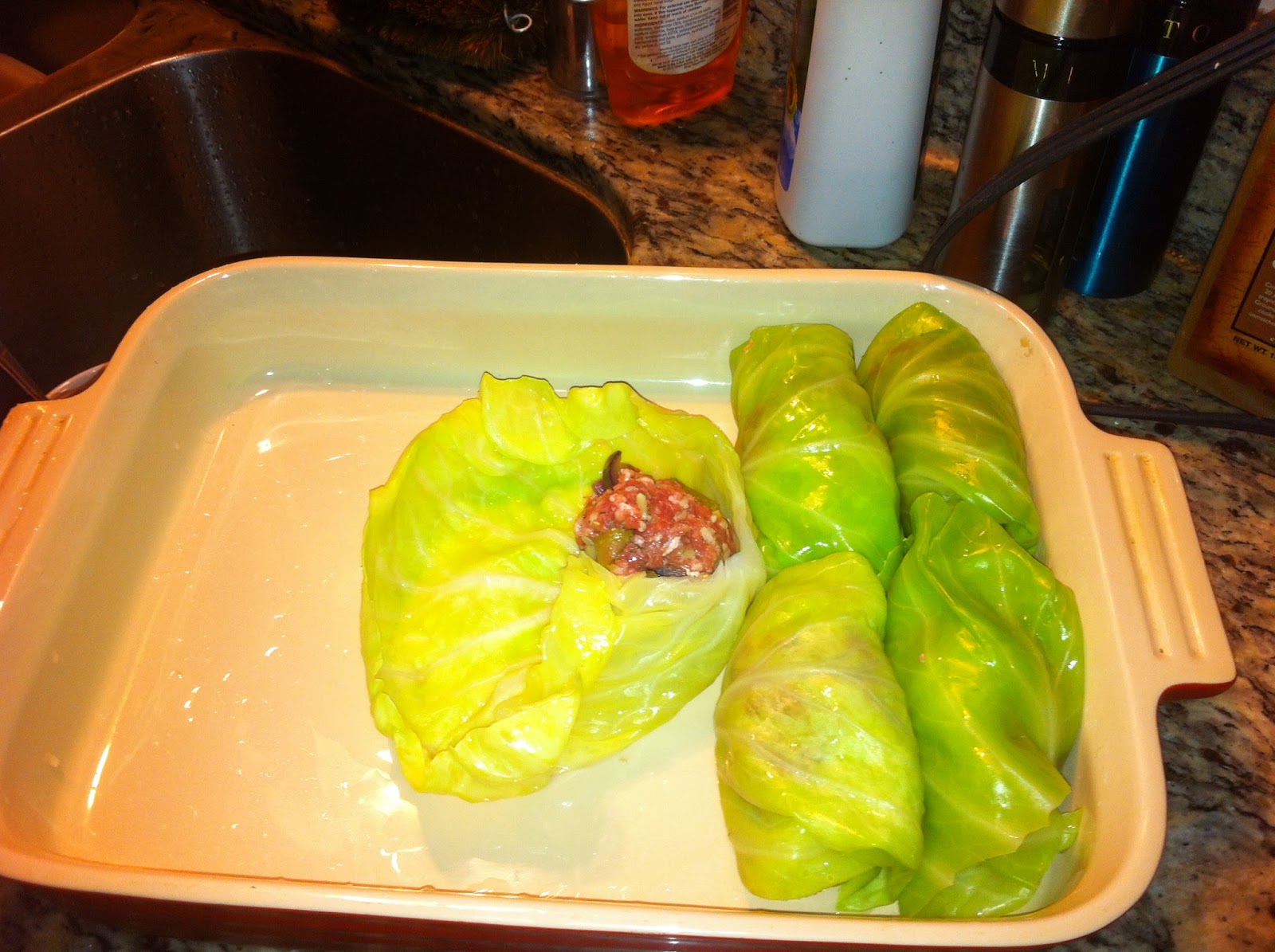

I baked it all at 350 for 1hr, covered with foil.


They were super nummy, and made for lots of easily portioned leftovers.  The cooked beef looks a bit odd because we are using grass fed beefalo.  I really liked the dill, which is an herb I underutilize.


Nutrient Unit 1.2lb ground beef 1 medium onion 3 large celery stalks 14.0"leaf, large"462.0g 1 cup brown rice cooked 1/16th tspn salt 1 tbspn olive oil TOTAL Serving
Water g 342 98 183 426 143 0 0 1192 170
Energy kcal 979 44 31 116 216 0 119 1505 215
Protein g 99 1 1 6 5 0 0 113 16
Total lipid (fat) g 65 0 0 0 2 0 14 81 12
Carbohydrate, by difference g 0 10 6 27 45 0 0 88 13
Fiber, total dietary g 0 2 3 12 4 0 0 20 3
Sugars, total g 0 5 4 15 1 0 0 24 3
Calcium, Ca mg 61 25 77 185 20 0 0 368 53
Iron, Fe mg 10 0 0 2 1 0 0 14 2
Magnesium, Mg mg 97 11 21 55 84 0 0 268 38
Phosphorus, P mg 892 32 46 120 162 0 0 1252 179
Potassium, K mg 1474 161 499 785 84 0 0 3003 429
Sodium, Na mg 347 4 154 83 10 155 0 753 108
Zinc, Zn mg 23 0 0 1 1 0 0 26 4
Vitamin C, total ascorbic acid mg 0 8 6 169 0 0 0 183 26
Thiamin mg 0 0 0 0 0 0 0 1 0
Riboflavin mg 1 0 0 0 0 0 0 1 0
Niacin mg 25 0 1 1 3 0 0 29 4
Vitamin B-6 mg 2 0 0 1 0 0 0 3 0
Folate, DFE µg 31 21 69 199 8 0 0 328 47
Vitamin B-12 µg 10 0 0 0 0 0 0 10 1
Vitamin A, RAE µg 0 0 42 23 0 0 0 65 9
Vitamin A, IU IU 0 2 862 453 0 0 0 1317 188
Vitamin E (alpha-tocopherol) mg 2 0 1 1 0 0 2 5 1
Vitamin K (phylloquinone) µg 6 0 0 0 0 0 0 6 1
Fatty acids, total saturated g 27 0 56 351 1 0 8 444 63
Fatty acids, total monounsaturated g 24


24 3
Fatty acids, total polyunsaturated g 3 0 0 0 0 0 2 5 1
Fatty acids, total trans g 4 0 0 0 1 0 10 14 2
Cholesterol mg 316 0 0 0 1 0 1 318 45

Saturday, January 25, 2014

Roasted Red Pepper Pasta Sauce -- Kidney Diet / Renal Diet


This recipe is in a series of indeterminate length on kidney-healthy foods.
The goal is to cook food that takes good, and meets the following nutritional guidelines:
<2000mg / day potassium
<1500mg / day sodium
Low to moderate protein content


Along with each recipe, I'll post the nutrition breakdown based on the USDA nutrient database.

Roasted Red Pepper Pasta Sauce


Tomatoes are on the verboten list in terms of low-potassium foods, and any sort of concentrated sauce doubly so, but spaghetti is a pretty common mid-week dinner in our house, so I tried making a sauce with a different base.

Ingredients:
  • 450g roasted red pepper (5 anaheim chillies turned red, and 5 sweet Italian peppers)
  • 2 large white onions
  • 0.8lb grass fed beef ('cause that was how much we had)
  • A lot of basil.  I estimated 1 cup of leaves
  • 1 cup low sodium chicken broth
  • 1 teaspoon salt
  • We used garlic, lemon juice, balsalmic vinegar, black pepper, and red pepper flakes to season.  I included the lemon and garlic in the nutrition table because they're the ones with potassium and sodium.

Directions:
  1. Fire roast the chilies. I saw an Alton Brown comment about using a metal in-pot basket steamer placed directly over a flame, and it worked great.  Basically you want them over a flame until they looked blackened in spots, then you place them in a pot with a lid and let them steam for 15min.
  2. De-seed and chop up the chillies.  Also chop up the basil and dice the onions
  3. Brown the beef in 1tbspn olive oil.  Set aside.
  4. Brown the garlic and onions in 1 tbspn olive oil.  Add to beef
  5. Degalze the pan with the chicken broth, add the peppers and basil, then use a stick blender to puree it all.  I was not patient enough to get a fine puree.  Next time I might use a blender or food processor instead
  6. Place everything in the pot back together, along with 1 tspn salt.  Simmer over low heat, and add black pepper, lemon juice, red pepper, and vinegar to taste.


This was the best thing I have made so far, but also the highest in potassium and sodium.  Definitely a sometimes food.  The salt could easily be reduced to 1/2 tspn once we're more acclimated to a low salt diet.  The balsalmic vinegar really added something.

Nutrition:
6 servings
Served over pasta (not included in nutrition totals)

Nutrient Unit 450g  red peppers 2 large onions 1 cup basil leaves Juice of 1 lemon 2 tblspn minced garlic 3tblspn olive oil 1tspn salt Grass Fed Beef 0.8lb 1cp low sodium chicken broth Total Per Serving
Energy kcal 598 120 6 11 9 358 0 695 38 1835 306
Protein g 4.68 3.3 0.76 0.17 0.38 0 0 70.3 4.8 84.39 14
Total lipid (fat) g 57.38 0.3 0.15 0.12 0.03 40.5 0 46.08 1.44 146 24
Carbohydrate, by difference g 29.56 28.02 0.64 3.31 1.98 0 0 0 2.88 66.39 11
Fiber, total dietary g 8.1 5.1 0.4 0.1 0.1 0 0 0 0 13.8 2
Sugars, total g 19.26 12.72 0.07 1.21 0.06 0 0 0 0.31 33.63 6
Potassium, K mg 868 438 71 49 24 0 0 1046 206 2702 450
Sodium, Na mg 94 12 1 0 1 1 2325 246 72 2752 459

Monday, January 20, 2014

Chile Relleño -- Kidney Diet / Renal Diet


This recipe is in a series of indeterminate length on kidney-healthy foods.
The goal is to cook food that takes good, and meets the following nutritional guidelines:
  • <2000mg / day potassium 
  • <1500mg / day sodium 
  • Low to moderate protein content 
Along with each recipe, I'll post the nutrition breakdown based on the USDA nutrient database.

Chile Relleño


This is the sort of thing I would never have put on my blog before I needed to start slavishly recording nutritional content, in that it is just a straight copy of another website's recipe with very few changes.

http://www.chow.com/recipes/29565-chiles-rellenos


Ingredients:
  • 6 poblano chilies (all peppers are low in potassium)
  • 5oz shredded cheese (we used part-skim mozzarella cause we had some)
  • 3 eggs, separated
  • Cholula or another hot sauce for condiment (nutritional value not shown, as it varies wildly from sauces.  None have much potassium, but sodium can be high)
Steps:
  1. Fire roast the chilies. I saw an Alton Brown comment about using a metal in-pot basket steamer placed directly over a flame, and it worked great.  Basically you want them over a flame until they looked blackened in spots, then you place them in a pot with a lid and let them steam for 15min.
  2. Slice open and de-seed the chilies, using a T shaped incision, that doesn't cut all the way through
  3. Stuff with cheese and close with a toothpick
  4. Heat enough oil in your pan to just cover the bottom
  5. Whip the egg whites until stiff, then fold in the mixed yolks
  6. Dredge eat chile through the egg mixture then plop it in the pan.
  7. Turn then as each side becomes a golden brown
I liked it a lot, though I am still getting used to the low-sodium flavors of things.  No picture sadly as it was late and I was hungry.  As a note:  Work quickly once you fodl the yolks into the whites as they will start to deteriorate.

I think i will use a modified version of this to make low-sodium homemade jalapeno poppers.

Nutrition

This serves two, three peppers each.  It would go well with tortillas.

Nutrient Unit 3 large eggs 6 poblano peppers 5oz cheese 4tbspn canola oil Total Serving
Energy kcal 214 76 360 495 1145 572.5
Protein g 18.84 4 g 34.39 0 53.23 26.615
Phosphorus, P mg 297 78 656 0 1031 515.5
Potassium, K mg 207 672 mg 119 0 326 163
Sodium, Na mg 213 12 mg 877 0 1090 545

Turkey Leek Soup - Kidney Diet / Renal Diet

This recipe is the first in a series of indeterminate length on kidney-healthy foods.
The goal is to cook food that takes good, and meets the following nutritional guidelines:


  1. <2000mg / day potassium
  2. <1500mg / day sodium
  3. Low to moderate protein content
Along with each recipe, I'll post the nutrition breakdown based on the USDA nutrient database.

Turkey Leek Soup


Leeks are a kidney friendly vegetable, and I like them in soup, so I thought I'd give this a try.  The ingredients are:
  • 0.5lb cooked (in my case smoked) herbed turkey breast
  • 4 cups low sodium chicken broth (from TJs, note: do not buy broth containing Potassium Chloride as a salt substitute)
  • 5 medium leeks, just the bulbs and lower leaves (~3 cups diced)
The prep was easy. I finely cut the bulb ends and top leves off the leeks and halved them, before blanching in boiling water for ~5min.  Then I rinsed them in a collander and chopped them finely.
I cut the leftover turkey into chunks, threw everything in a  pot and let it all simmer for 2hrs.

First let me say that my salt-loving palate this soup tasted bland.  It definitely needed more bite, and I will play with that in future iterations.  That said, the smokiness from the turkey really added needed flavor, so I recommend using smoked meat.  The herbs from the turkey (a standard herbs de'provence mix) also helped. 

Extreme Soup close-up

Serving suggestion:  We ate this with sourdough bread, and found the sourness complemented the coup well and added some of that missing bite.  I definitely recommend this, especially as sourdough bread is high in neither potassium nor sodium.

Nutrition

Recipe makes 4 servings (~2cups each)
Nutrient Unit 3cups boiled leeks 4 cups low Na broth 250g roasted turkey breast Total 1 serving
Water g
283.3
921.6
169.7
1374.6
343.65
Energy kcal
97
154
367.5
618.5
154.625
Protein g
2.53
19.2
75.325
97.055
24.26375
Total lipid (fat) g
0.62
5.76
5.2
11.58
2.895
Carbohydrate, by difference g
23.77
11.52
0
35.29
8.8225
Fiber, total dietary g
3.1
0
0
3.1
0.775
Sugars, total g
6.58
1.25
0
7.83
1.9575
Minerals


0
0
0
Calcium, Ca mg
94
38
22.5
154.5
38.625
Iron, Fe mg
3.43
2.02
1.775
7.225
1.80625
Magnesium, Mg mg
44
10
80
134
33.5
Phosphorus, P mg
53
288
575
916
229
Potassium, K mg
271
826
622.5
1719.5
429.875
Sodium, Na mg
31
288
247.5
566.5
141.625
Zinc, Zn mg
0.19
0.96
4.3
5.45
1.3625
Vitamins


0
0
0
Vitamin C, total ascorbic acid mg
13.1
0
0
13.1
3.275
Thiamin mg
0.081
0
0.0875
0.1685
0.042125
Riboflavin mg
0.062
0.288
0.5125
0.8625
0.215625
Niacin mg
0.624
13.152
29.375
43.151
10.78775
Vitamin B-6 mg
0.353
0.096
2.0175
2.4665
0.616625
Folate, DFE µg
75
0
22.5
97.5
24.375
Vitamin B-12 µg
0
0.96
0.975
1.935
0.48375
Vitamin A, RAE µg
128
0
7.5
135.5
33.875
Vitamin A, IU IU
2533
0
27.5
2560.5
640.125
Vitamin E (alpha-tocopherol) mg
1.56
0
0.15
1.71
0.4275
Vitamin D (D2 + D3) µg
0
0
0.75
0.75
0.1875
Vitamin D IU
0
0
25
25
6.25
Vitamin K (phylloquinone) µg
79.2
0
0
79.2
19.8
Lipids


0
0
0
Fatty acids, total saturated g
0.084
1.718
1.4825
3.2845
0.821125
Fatty acids, total monounsaturated g
0.009
2.63
1.565
4.204
1.051
Fatty acids, total polyunsaturated g
0.346
1.21
1.32
2.876
0.719
Cholesterol mg
0
0
0.06
0.06
0.015

Sunday, January 12, 2014

Banana Cream Trifle

I decided to make a Banana Cream Trifle for a monthly gathering, which is basically a fancied name for banana pudding.  Originally if was going to be a banana cream pie, but since nilla wafers are better than crush with banana pudding, why make crust?

OK, so this is a pretty simple concept with 4 ingredients:

1)  A layer of vanilla wafers.  Traditionally you use the 'Nilla wafer brand, but I was at Trader Joe's and so I used their "ultimate vanilla wafers".  They worked well, and I endorse them

2) Bananas.  You need 3 and they should be ripe, y'know with no green and some brown.

3) Whipped Cream.    I made my own, using 1.5c heavy cream and ~2tbspns confectioners sugar whipped in a freezer-chilled metal bowl.

4) Pastry Cream.  More on that below.


The first step was making the pastry cream, and I pretty much followed steps 3 & 4 of this recipe:
http://www.marthastewart.com/331723/banana-cream-pie

However, when I make this again I will introduce a few caveats:

  • `5tbspns corn starch is a bit excessive, and gave a slightly chalky taste to me, at least before cooking.  On food and cooking recommends 5-10g / 0.5- 1tbspn per cup of milk.  I think next time I will do 3.5tbspn or 4 total.
  • Straining is for suckers
  • Whisking is for suckers, and scrapes pots.
  • Egg yolk amylase will digest your starch overnight if the mix is not brought to a boil and kept there for a minute.  This is very different from a creme anglaise or egg only custard which needs to be kept from boiling.  I believe this is why step 4 says "until bubbles appear in the center".  In any case, don't be too skittish with the heat.
  • I added 2 tspns of vanilla extract to the pastry cream once I had removed it fromt he fire.  This added a lot flavor-wise
  • Instead of letting this cool in the fridge over night and then assembling the pie, I should have poured it over the wafers right away.  It is a pain to work with once solidified.


That was so many caveats that I am just going to re-write my process:
  1. In a pot combine 4tbspn corn strach, 1/4 tspn salt, 2/3 cup sugar, stir to mix
  2. Gradually add 3 cups whole milk, stirring to mix
  3. Heat over medium low heat until the milk begins to thicken from the starch
  4. Turn off the heat, and whisk 1/4 of the mixture into a bowl containing 4 egg yolks
  5. Dump this mix back into the pot
  6. Continue to heat over LOW heat with constant stirring, until the mixture boils/bubbles int he middle.
  7. Immediately transfer to a new container


The last step was assembly.  

First I layered wafers to cover the bottom of the pie pan, first in on layer, and then with a sparse second layer of upside down wafers to cover the natural gaps.  Second I stood wafers up around the edge of the pan.  I thought this made a pretty effect. Next, I added 1/2 the pastry cream, followed by a layer of sliced banana, then another layer of pastry cream followed by a second banana layer.  On top of all this I spread whipped cream.


Much as I remembered from my childhood, this dish was better than the sum of its parts.  So good in fact, that we had devoured it all before I thought to take a photo:


In conclusion, I recommend this for the crust-phobic or effort phobic, or anyone who just likes cream pies.

P.S.  Look at the pretty pie plate I got for Christmas!

Saturday, November 16, 2013

Smoked Brisket

I have a smoker.  Well technically it is a Weber grill with a smokenator in it.

I also joined a beef CSA, so I decided to try a brisket, and see how it compares against the oven.  (hint: smoker wins)

Step 1:
I started with a 2.5lb grass fed beefalo brisket (Not sure what part of the brisket it came from, but it was super lean 'cause that's how grass fed beefalo rolls.  rolls?  roams?

I let it thaw, and coated it super liberally with a mix of 2pts salt, 1pt black pepper, 0.5pt ancho chilli and 0.5pt dry mustard.  I rubbed this all over, and let it sit overnight.  As it turns out, this was too much salt for a small piece of meat with a high surface to volume ratio.

Here it is in all its glory


Then I fired up my weber to 225-250F (I am still learning to keep it steady so there was a lot of variance through the day), added some hickory wood, and my brisket.  It turns out that like salt, hickory wood is best used in moderation, and instead of thin blue smoke (which I am told is best) I had great billows of grey-white smoke.  The amount of smoke actually inhibited the fire for a bit, and kept the temp too low.  Because of this I felt I could taste an acridity in the bark, but my other taste tester could not.

At 150F internal meat temp I opened the grill up and wrapped the brisket in foil .  Then I let it all be until 203F, at which point I transferred it to my toaster oven set on warm (140F) to "rest"for an hour.

OK, here's the final product:


From 2.5lb start, I was left with a little over 1.5lbs cooked meat.

Flavor wise I was disapointed by the saltiness and smokiness, but these are easily fixed in future runs (for now I just picked some of the bark off my slices before eating).

Texture wise this was some of the best brisket I have had.  it was very very juicy compared to the oven method.  I was especially surprised because Beefalo is a low-fat meat.

It went well with corned bread and braised cabbage.  (I used this recipe for cabbage and I think I ate half of it: http://www.chow.com/recipes/10712-braised-red-cabbage-with-bacon)

Fun fact to end the post:
I reek of hickory smoke.

Wednesday, October 16, 2013

Old Time Gingerbread and New Fangled Lemon Curd

It's Fall!  It's not 90F+ in my kitchen!
Let's bake.

These are two recipes I made for a tea party.

The first is gingerbread from Beeton's Book of Household Management  (you know my love of historical British cookery).

Here's the text:

THICK GINGERBREAD.

1760. INGREDIENTS.—1 lb. of treacle, 1/4 lb. of butter, 1/4 lb. of coarse brown sugar, 1-1/2 lb. of flour, 1 oz. of ginger, 1/2 oz. of ground allspice, 1 teaspoonful of carbonate of soda, 1/4 pint of warm milk, 3 eggs.
[Illustration: GINGERBREAD.]
Mode.—Put the flour into a basin, with the sugar, ginger, and allspice; mix these together; warm the butter, and add it, with the treacle, to the other ingredients. Stir well; make the milk just warm, dissolve the carbonate of soda in it, and mix the whole into a nice smooth dough with the eggs, which should be previously well whisked; pour the mixture into a buttered tin, and bake it from 3/4 to 1 hour, or longer, should the gingerbread be very thick. Just before it is done, brush the top over with the yolk of an egg beaten up with a little milk, and put it back in the oven to finish baking.
Time.—3/4 to 1 hour. Average cost, 1s. per square.
Seasonable at any time.


I basically followed this one by-the-book, but for a few changes:
  1. I replaced baking soda with baking powder, and in doing so increased the volume to 3x (1tbspn) since baking powder is 1/3 baking soda by volume
  2. I ignored her mixing instructions, which seemed frankly bizarre and instead mixed ala the muffin method (mix all the dry ingredients together, all the wet together, then just combine)  
  3. I did not have a 1lb of treacle, so I used 1lb of cane syrup, which is basically the same thing as dark treacle
  4. There's no temperature, so following a recipe in another cookbook I did 375.  This was a mistake.  By 45min the gingerbread was done, but I found it quite dry when eating it, best slathered with jam or dunked in tea.  For a moister version I might try 325.*
*Then again, maybe it's supposed to be dry and not moist?  I feel like a lot of what I have baked lately is slightly dry, and this may be because I have switched to stoneground whole wheat flour from whole kernels.  Hmm. . .

I would totally recommend this, with the baking time change caveat or a lot of jam.

My photo standards are really going down hill.

NEXT we jump forward from the pinnacle of 1850s cookery to maybe the pinnacle of 1950s cookery with microwave lemon curd.

To be honest, I was not going to post on this because it's mostly cribbed from one recipe and there are so many variants out there, but I got some requests so here it goes.

Googling "lemon curd" I came across this recipe by Gordon Ramsay:

"Ingredients for about 1 1/2 cups Lemon Curd:
3 whole large eggs
3/4 cup white sugar
2/3 cup freshly squeezed lemon juice
1 1/2 tbsp freshly grated lemon zest
5 tbsp unsalted butter, room temp, cut in 3 or 4 pieces"


It seemed perfect.  By a British person?  check.  Not having to separate yolks? check.
But you may notice the complete lack of ummm instructions on the page.
This lead to more googling for correct addition order, in which I found many sites claiming you could skip the bain marie and just do this in a microwave!  (I know many chefs skip bain maries anyway and go directly to the stove, but I would totally burn it that way.)

I had to try!

These are the changes I made:
  1. I used 4tbspn butter because I was doubling the recipe and that meant I could use one stick
  2. I used something closer to 2-3tbspn zest (6 in total) because I LOVE zest.  basically just zest every single lemon.  Yummmm
  3. I think I may have used 1/2cup sugar.  Honestly recipes really vary on this.  I would say use the standard amount unless you are trying to cut back for some reason.  
The method I followed:
  1. Melt the butter
  2. Throw everything in a bowl
  3. Taste it (yes I know there is raw egg).  make sure it's not too sweet or sweet enough
  4. Whisk it until blended
  5. Microwave for 1min
  6. Whisk until blended
  7. Iterate 5&6 until it starts ballooning in size
  8. Microwave in 30sec increments with lots of whisking maybe 3-4 more times
  9. Take a small amount on a spoon and put it in the freezer for a minute.  Does it firm up?  If yes you are done cooking, if not, microwave some more
  10. Strain the lemon curd through a mesh strainer to remove zest bits and make a smoother consistency
  11. Chill
So good there's none left


The one thing I was really disappointing in that I made for the tea party was scones.  They came out like really dense sugar cookies.  I will be working on scone recipes in the coming few weeks trying to perfect one, because seriously!